Custom software development

Your idea.
Your software.

Custom software, AI solutions, apps and web applications built around your business.

Services and project questions in detail

Let's find a way.Easier than you think. Cheaper than you think.

Fixed price offer · Clear scope of services

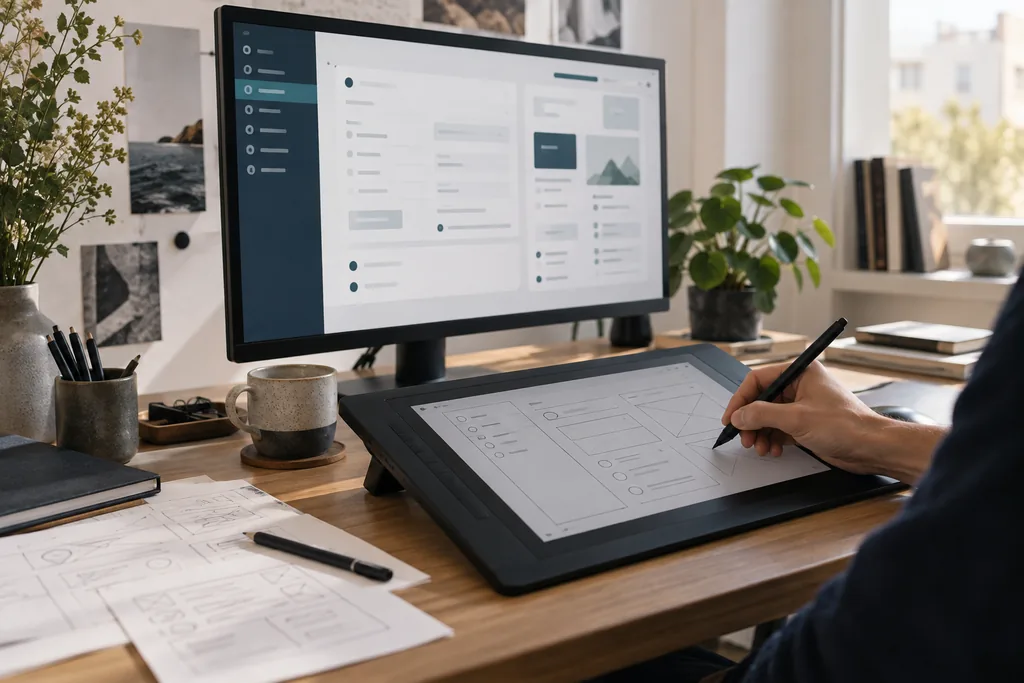
Design of custom software with pen, drawing tablet and application view on the screen.
Software starts with your day-to-day work.AI-generated illustrative image

Quite simply. In 5 steps.

One point of contact. Developed together.

  1. 01

    Call

    You share your idea.
    I take notes.

  2. 02

    Requirements brief

    I document
    what you need.

  3. 03

    You add details

    You review the requirements.
    We refine the details.

  4. 04

    Specification + quote

    What you get.
    With a clear fixed price.

  5. 05

    Your prototype

    Within 14 days
    of commissioning.

Try it out. Refine it together.Your feedback helps us turn the prototype into software ready for everyday use, step by step.
14 daysto your prototype · at most
6 weeksto the pilot phase · typically

What should your software do?

Does standard software not quite fit?
We build around your workflow.

Everything is also possible with AI support.Understandable, practical and reliable usable.

For SMEs, tradespeople, service providers and founders · as well as municipalities, freelancers and individuals.

Services in detail

Develop custom software: from bottleneck to solution.

KAN KAI WORKS develops software and apps for companies whose processes only work via detours with existing tools. The focus is on a concrete way of working: collecting information, preparing decisions or handing over processes between people and programs. This results in the appropriate range of functions.

A meaningful first stage of development

In the beginning, we do not collect as many functions as possible, but consider a complete process. Which input starts it, who edits it and when is it completed? A limited core makes the design manageable and helps you assess benefits and usage early on.

Introduction is part of development

A new application must fit into day-to-day operations. We therefore plan data migration, user roles and the order of rollout. Representative examples help you check the workflow and identify any adjustments needed before launch.

Technical implementation

What determines the technical basis of your software.

The technical form follows the workflow. Before development, we clarify where the application runs, what data it processes and how it will be maintained later.

Data and work steps

What information belongs together, what states does a process have and who is allowed to change it? A coordinated data model prevents the same information from being maintained differently at several points.

Access and deployment

Browsers, mobile devices, number of users and required availability influence the architecture. Login, roles and accesses are considered on the server side; hosting and the integration of existing systems are part of the planning.

Introduction and ongoing operations

Test environment, data migration, backups and recovery are considered together. Updates require auditable core processes and a responsibility that detects errors or failed tasks in the operation.

Helpful for planning

A sample process, a list of existing programs, the intended user groups and the devices in everyday work are helpful.

Which of these questions is crucial for your project? Briefly describe your process and the existing systems.

Discuss technical requirements

Project start

What we clarify before development.

When is custom software worthwhile?

If recurring processes with existing tools only work via detours. We first look at a concrete process, the people involved and the desired outcome.

Can existing systems be connected?

We check available interfaces, access rights and data formats. If an extension of the existing system is sufficient, a Individual plugin It is the right solution.

How are the scope and costs determined?

The coordinated functions result in a clear range of services with a fixed price offer. Operation, maintenance and subsequent extensions are discussed separately.

Above all, I need a company website – does this fit here?

For a representative appearance with services and contact paths Web design The right way to start. Apps and portals come into play when users are supposed to work with data, accounts or operational processes.

What information do I need for a project request?

Describe today’s flow, the people involved and the programs you already use. A concrete bottleneck and a desired result help more than a long technical wish list. Confidential documents can later be specifically coordinated.

How do we distinguish necessary functions from later ideas?

We assign each function to the agreed core sequence. What is necessary for its use belongs in the first planning. Further requests are recorded as possible expansion stages and prioritized after feedback from the use.

What happens after the first publication?

Operation, maintenance, troubleshooting and further development are agreed with responsibilities and scope. Feedback from everyday life can then help to plan the next improvements.

One idea is enough.

I'll review your idea with no obligation .
On request, we start with a small prototype.

  • What do you want to implement?
  • What can the software do?
  • New idea or existing application?