Data & improvements

Connect existing systems.
Improve what matters.

Make data usable, connect programs and further develop existing software. Looking at what already works.

Services and project questions in detail

Developed for your company · with a fixed price offer

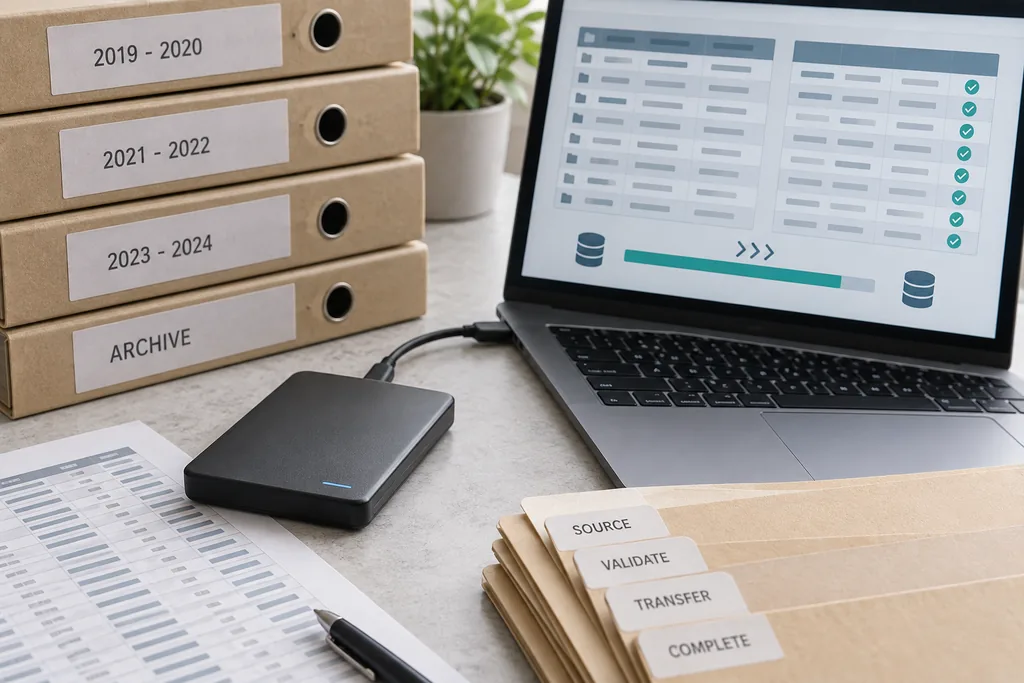
External data carrier, archive documents and two table views on the laptop for data transfer.
Understand the existing. Targeted further development.AI-generated illustrative image

Example concept

Understand what's there.
Improve what is missing.

An inventory shows data paths, dependencies and open points. This results in a comprehensible plan for interfaces, new functions or technical improvements.

  1. 01Analysis

    Understand inventory, data pathways and problems.

  2. 02Coordinate

    Plan changes and transfers appropriately.

  3. 03Testing

    Compare results and existing processes.

What should your solution do?

Choose an area.
The examples show possible building blocks.

The examples are suggestions for individual development. Functions, data and connections are tailored to your actual needs.

01 / Possible implementation

Databases and interfaces between existing programmes

An interface requires more than one connection between two programs. Data fields, unique identifiers and update rules shall match. We define which system carries which information and how failed transmissions are detected, corrected or processed again.

  • Include existing data sources and available interfaces.
  • Define fields, transmission paths and matching rules.
  • Schedule error cases, protocols and repeatable transmissions.
Back to overview ↑
02 / Possible implementation

Further development and revision of existing software

An existing application can often be improved in a targeted manner if its structure and dependencies are traceable. We check source status, data model and affected ways of use. New functions are complemented in coordinated steps and compared with the processes to be obtained.

  • Check source status, technology and dependencies together.
  • Add features and navigation that fit the existing application.
  • Gradually compare changes with existing processes.
Back to overview ↑
03 / Possible implementation

Error analysis and technical optimization

For a technical improvement, a reproducible problem is first narrowed down. Example process, expected behavior and measured values help with the root cause analysis. After a correction, we check both the original error and adjacent functions that may be affected by the change.

  • Repeat errors with the required steps and data.
  • Targeted investigation of runtimes, queries or data paths.
  • Check corrections and document the results in a comprehensible manner.
Back to overview ↑

Services in detail

Data migration and software maintenance with testable results.

In existing applications, a lot of expertise is often already implemented. A further development therefore begins with an understanding of the existing data, rules and dependencies. We define which function must be maintained and which change improves a concrete process.

Keep migrations under control

For a data migration, source fields, target structure and special cases are assigned. A test run shows missing values, duplicates and different formats. For the acceptance, we determine which quantities, relationships and example processes are compared with the initial stock.

Find the root cause of errors

A slow report or a faulty import is examined with traceable steps. For this, example values, time and expected result are helpful. Changes are then checked against the specific error and affected inventory processes.

Implementation questions

What do you need to adopt an existing application?

Information on technology, source status, dependencies and delivery is helpful. Which accesses are actually necessary will be agreed in advance. Confidential access data does not belong in the first project request.

Can we keep the existing interface?

If it provides good services to users, a targeted change in the background or individual functions may suffice. The inventory analysis shows which dependencies must be taken into account.

How is a data reconciliation checked?

We agree on unique identifiers, authoritative sources and update rules. Protocols and representative test cases help to identify whether data sets have been transferred completely and assigned to the correct operations.

Technical implementation

Migrate data without losing context.

Before migration or further development, we check the existing status and determine how results and existing functions are compared.

Structure and data quality

Fields, relationships, identifiers and character formats shall be assigned. Mandatory values, duplicate records and incomplete entries require their own rules. A trial import shows which corrections are required before full adoption.

Existing systems and dependencies

Source code, runtime environment, libraries and external interfaces affect a change. We are looking at how the application is built, deployed and secured. Missing access or documentation will be considered as part of the effort.

Migration and rollback

Data backup, test acceptance and comparison of quantities or results are planned in advance. For the change, we clarify writing breaks, subsequent changes and a possible relapse. Core processes are re-examined after the conversion.

Helpful for planning

Data examples, an overview of source code and hosting, interface descriptions and concrete error or change examples are helpful.

Which of these questions is crucial for your project? Briefly describe your process and the existing systems.

Discuss technical requirements

Built around your existing setup.

Build on what you have

Existing systems are understood first. Which interfaces, source statuses and rights of use are available decides the sensible way.

Suitable for use

Acquisitions and changes require clear allocations, suitable hedges and auditable results. These steps are planned in advance.

With a clear start

A single data path, error or functional request can be the starting point. Further changes follow on a reasonable basis.

What do you want to simplify?

You show me your process. Together we look at which custom solution fits this.

  • What takes up most of your time today?
  • What programs are you already using?
  • What would be a helpful first step?