

Materials & operations

Everything in sight.
Ready for action.

Manage materials, tools and vehicles appropriately. So that it becomes visible what is available, who uses it and what is next.

Services and project questions in detail

Developed for your company · with a fixed price offer

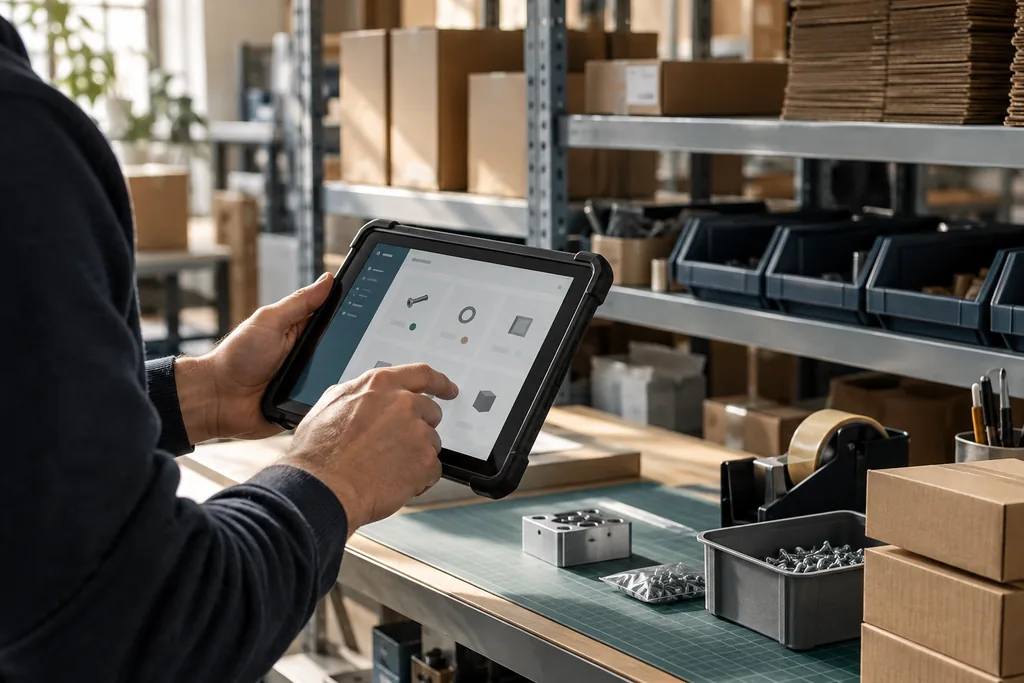
Person uses a tablet for material management at an orderly warehouse workstation.
From stock to next work step.AI-generated illustrative image

Example concept

In stock.
Associated. Ready for use.

A common stock could connect materials, locations and reservations. Use and maintenance remain traceable directly on the respective object.

  1. 01Coverage

    Determine inventory and locations.

  2. 02Assignments

    Plan expenses and reservations.

  3. 03Caring

    Track returns and maintenance.

What should your solution do?

Choose an area.
The examples show possible building blocks.

The examples are suggestions for individual development. Functions, data and connections are tailored to your actual needs.

01 / Possible implementation

Warehouse and material management services

A warehouse management may represent quantities, storage locations and planned needs together. For this, we distinguish actual inventory movements from reservations for upcoming orders. Units, minimum stocks and corrections are coordinated so that a displayed availability in everyday work remains comprehensible.

  • Items, storage locations and minimum stocks managed in a clear manner.
  • Assign inputs and outputs as well as material outputs to an order.
  • Complete barcode or QR collection and follow-up order information as necessary.
Back to overview ↑
02 / Possible implementation

Maintenance and test management

Maintenance tasks are related to the device, appointment and responsible person. One possible solution combines results with documents and open follow-up measures. For mature or blocked items, separate conditions are agreed; the professional requirements and intervals are reflected with your specifications.

  • Record dates and responsibilities for individual items.
  • Assign results, documents and next steps directly.
  • Show open measures and due tasks in an overview.
Back to overview ↑
03 / Possible implementation

Machinery, tool and equipment management services

A device management looks at each relevant device with its own identifier, location and current state. Reservation, issuance and return can be separate steps. In this way, it is also possible to detect whether accessories are missing or whether a test is necessary before the next use.

  • Recognize the location, user and condition of a device.
  • Manage reservations and handovers for planned missions.
  • Document damage, accessories and returns directly to the item.
Back to overview ↑
04 / Possible implementation

Fleet management

Vehicle data, planned use and operational documentation can converge in a common view. What information is actually needed depends on your fleet. We coordinate responsibilities, schedules and desired evaluations without automatically requiring location or additional data collection.

  • Show vehicles, responsibilities and planned use.
  • Bundle maintenance dates and operational documents.
  • Collect cost and usage data for own evaluations.
Back to overview ↑

Services in detail

Stock, equipment and availability in one place.

Individual material and equipment management distinguishes between existing, reserved, issued and ready for use. These conditions are not the same in everyday life. Together we plan which movements have to be recorded so that warehouse, office and field service can work with a reliable overview.

Differentiate material and individual equipment

Consumables are supplied by quantity; a machine may require its own identifier, location and usage history. These differences determine the input forms. Reservations, returns and locked devices are scheduled as separate operations.

Expenditure until return is thought through

A device goes to a team with accessories and comes back later with a damage. The process can merge transfer, state and next measure. A return alone does not have to mean a new release for the use.

Implementation questions

Can existing Excel lists be adopted?

We check columns, identifiers, units and data quality. An adjusted sample set is first imported and compared. Only after the coordinated allocation will further stocks be transferred to the new structure.

Is it possible to collect by QR code or barcode?

This can be scheduled for articles or clearly marked devices. For this purpose, we clarify existing labels, scanners or cameras and the specific work step that a scan should trigger.

Can the application recall maintenance?

Dates and information can be planned based on agreed intervals or collected usage data. You provide the technical test specifications; responsibility, proof of completion and new release are defined separately.

Technical implementation

Manage stock and equipment with the right data model.

Quantities, individual devices and reserved resources require different rules. This separation forms the basis of administration.

Stock movements and identifiers

Consumables are carried over quantities and units, individual devices via their own identifiers. Issuance, withdrawal and correction need a clear reference. Simultaneous bookings must not conflict with the quantity available.

Scanning and working on the road

Barcode, QR code, camera and existing labels must fit together. We check typical equipment and lighting conditions. For recording without a network, intermediate storage, synchronization and handling of double bookings are planned.

Condition and re-release

Returned, damaged and ready for use are separate states. Maintenance data, documents and responsibilities are assigned. The technical examinations that are required and who releases a device is explicitly specified.

Helpful for planning

A list of items with units, device identifiers, existing labels and a typical output and return process are helpful.

Which of these questions is crucial for your project? Briefly describe your process and the existing systems.

Discuss technical requirements

Built around your existing setup.

Build on what you have

Existing lists of articles and equipment stocks can be taken over after examination. Connections to purchasing or order management are planned appropriately.

Suitable for use

Office, warehouse and field service require different inputs and views. These roles are aligned with the real workflow.

With a clear start

We can start with a clearly defined inventory or device list and supplement usage, maintenance and evaluation.

What do you want to simplify?

You show me your process. Together we look at which custom solution fits this.

  • What takes up most of your time today?
  • What programs are you already using?
  • What would be a helpful first step?